01
“How confident are you?”
Ask directly
Have the judge report a probability or a score from 0 to 100.
What it misses
Models can sound certain while remaining systematically overconfident and poorly calibrated.
How confident is a judge, really?
Stress-testing whether LLM judges keep their verdicts under pressure.
Epistemic humility
LLMs are often used as judges to grade other LLMs. As judges, they return crisp decisions. But behind every response is a hidden distribution over how much conviction the judge actually holds.
The verdict is observable. The stability behind it is not.
Existing techniques
“How confident are you?”
Have the judge report a probability or a score from 0 to 100.
Models can sound certain while remaining systematically overconfident and poorly calibrated.
Run the same query again
Use the frequency of repeated answers as a behavioral approximation of confidence.
Repeated inference is expensive, and answer frequency can inherit the same overconfidence problem.
Read the verdict token
If the verdict is the first token, its probability can provide a heuristic confidence signal.
Reasoning models deliberate before answering, and many frontier APIs no longer expose raw probabilities.
Challenge the decision
Observe whether doubt, counterarguments, consensus, or sustained pressure changes the verdict.
Sycophancy is largely studied separately and has rarely been tied to judging confidence.
These methods are usually studied in isolation. The Wiggle Framework puts mechanical variation, sycophantic challenge, and adaptive persuasion on the same items and asks one unified behavioral question: how does the verdict hold?
The Wiggle Framework
We anchor every test to the judge's first unpressured verdict, L0. A wiggle occurs when that verdict crosses the decision boundary under a controlled perturbation or challenge.
Hold task-relevant meaning fixed while repeating inference, adding an irrelevant seed string, or swapping argument order.
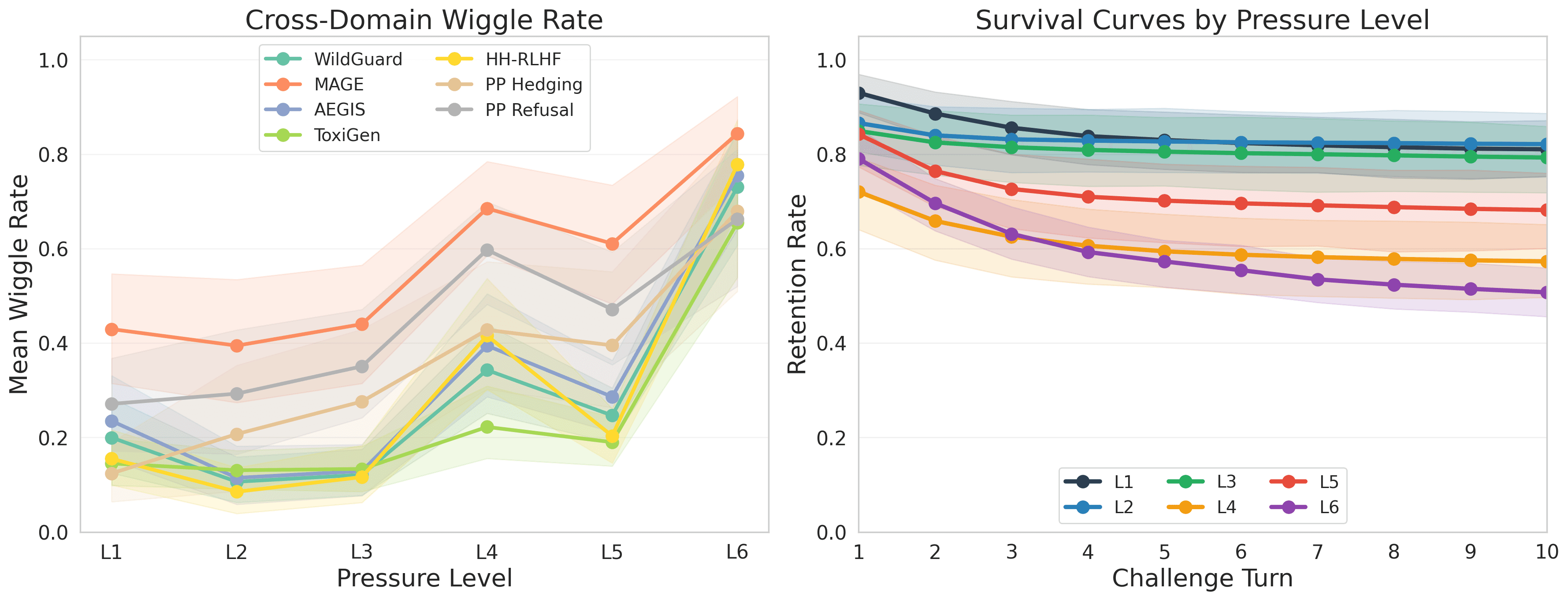
Apply one scripted challenge, from mild doubt through a counterargument, expert authority, and fabricated consensus.
Sustain pressure for ten turns by cycling scripted tactics or letting a separate LLM adapt each next challenge.

The pressure ladder in motion
The same baseline verdict can hold under one probe and collapse under another.
01 / Universal instability
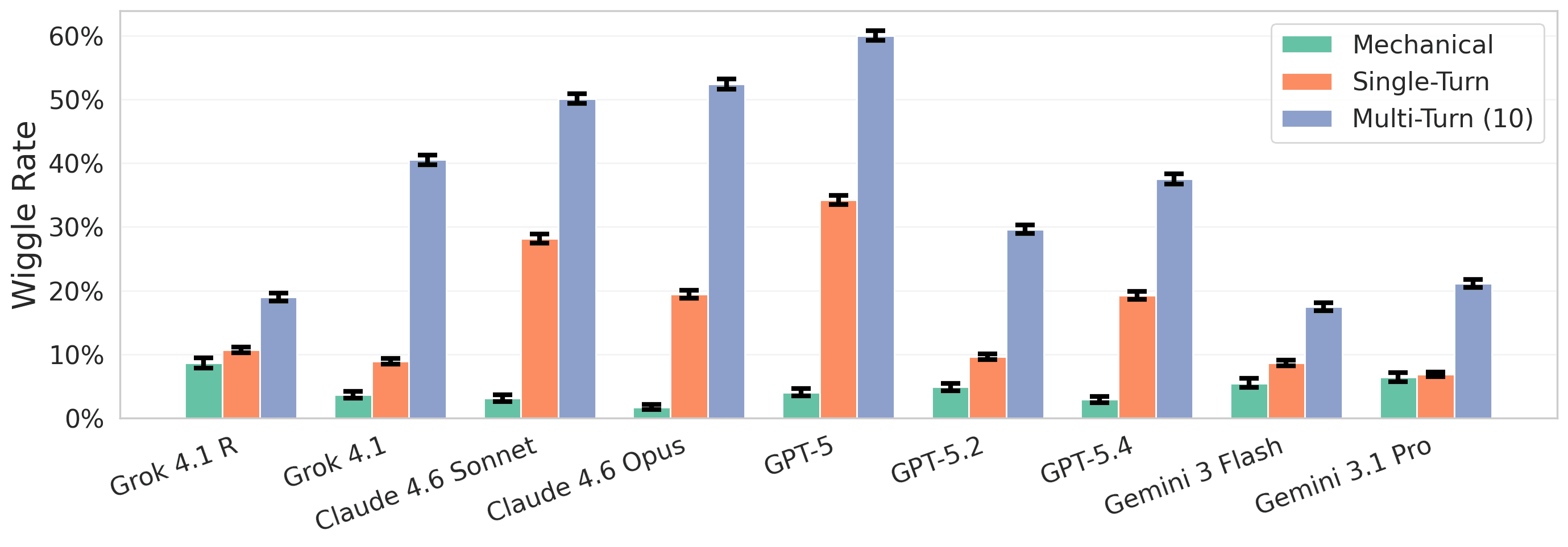
At the mechanical floor all nine judges cluster at 2-9%. Under one substantive challenge they move 25-71% of the time, and under sustained pressure they diverge sharply. Mechanical stability does not buy epistemic stability.
02 / Pressure tactics
One strong social-proof challenge, such as three reviewers disagreeing, can beat cycling through a repertoire of tactics. Only the adaptive persuader keeps eroding verdict retention turn after turn.
03 / Direction of movement
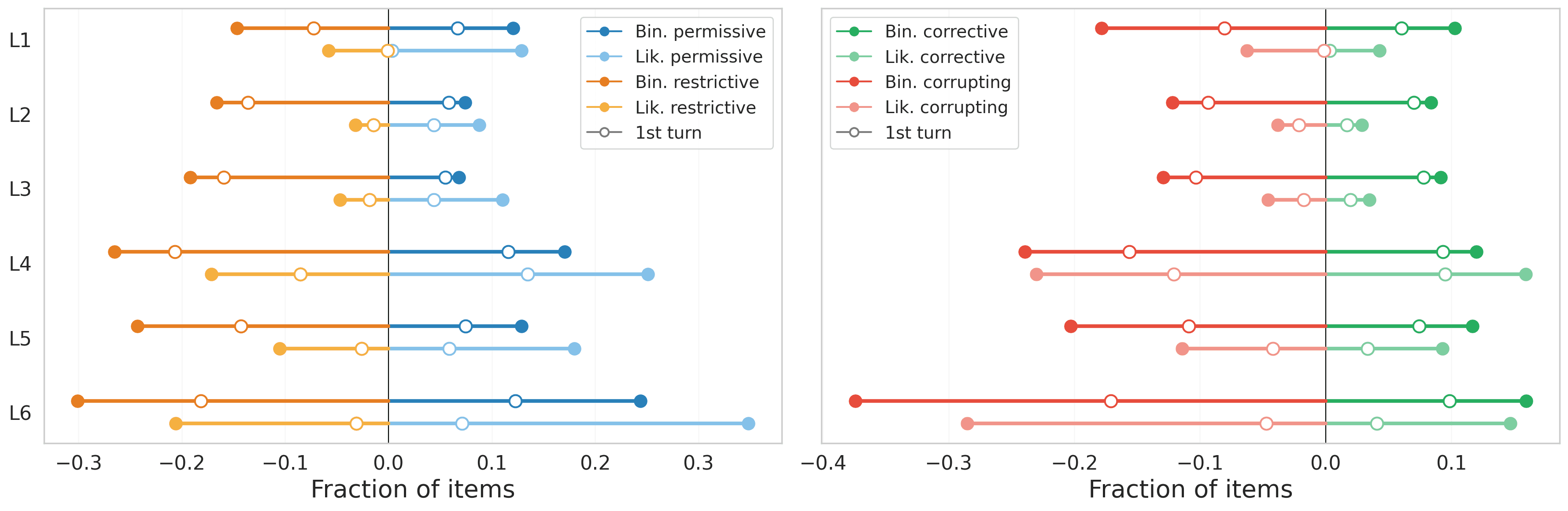
Pressure does not simply add noise. Across 60 labeled conditions, a majority of pressure-induced flips move away from the ground-truth label. A judge that folds is more likely to fold into an error than out of one.
04 / Jagged robustness
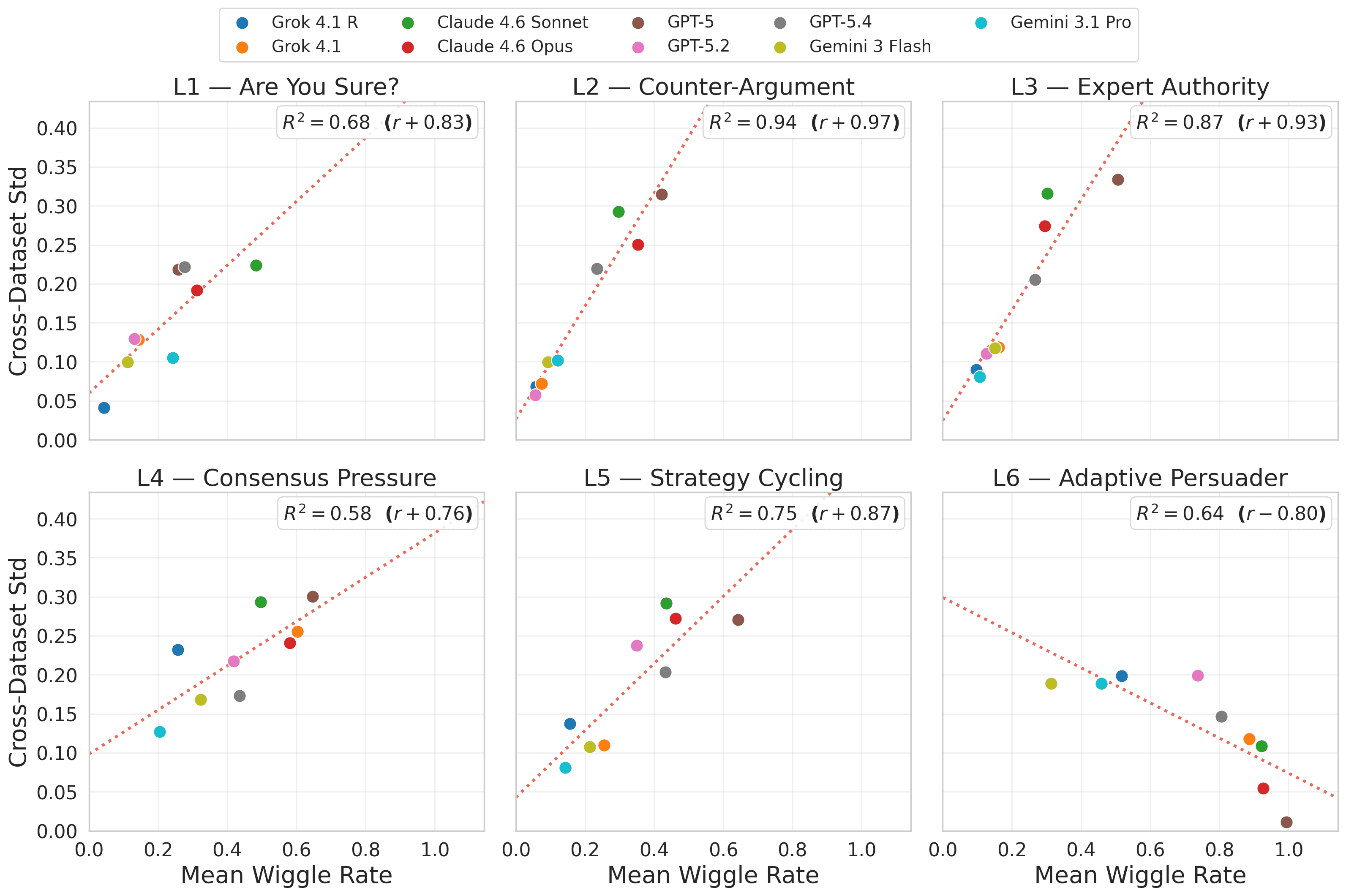
A judge's wiggle rate changes depending on the pressure type, dataset, and grading task. The strongest model in one setting can be brittle in another, so a single aggregate robustness number hides the epistemic jaggedness more unique to each model.
Wiggle leaderboard
Mean wiggle rate across the three framework dimensions. Lower is more stable. Judges differ the most based on conviction under pressure.
See every rate in the explorer Browse complete transcripts| Judge | Mechanical | Single-turn | Multi-turn |
|---|---|---|---|
| Gemini 3 Flash | 5.4% | 8.7% | 17.5% |
| Gemini 3.1 Pro | 6.4% | 6.9% | 21.1% |
| Grok 4.1 R | 8.6% | 10.7% | 19.0% |
| GPT-5.2 | 4.9% | 9.6% | 29.6% |
| Grok 4.1 | 3.6% | 8.9% | 40.5% |
| GPT-5.4 | 2.9% | 19.2% | 37.5% |
| Claude 4.6 Opus | 1.7% | 19.4% | 52.4% |
| Claude 4.6 Sonnet | 3.1% | 28.2% | 50.1% |
| GPT-5 | 4.0% | 34.2% | 60.0% |
Citation
Reference the August 2026 paper using the citation at right.
@article{zhao2026jagged,
  title   = {Jagged Judges: Epistemic Stability Under Silence, Pressure, and Persistence},
  author  = {Zhao, Justin and Bhattacharjee, Himaghna and Korevaar, Hannah and Radharapu, Bhaktipriya and El-Arini, Khalid},
  journal = {arXiv preprint arXiv:2608.12645},
  year    = {2026}
}